
All posts by singlemalt

Born and raised in Los Angeles. Licensed Industrial real estate agent since 1994.

Slaughterhouse Scarcity

A New York Times article describes some of the challenges of local-food movements across the country: a lack of slaughterhouses.

...growing problem for small farmers here and across the nation: too few slaughterhouses to meet the growing demand for locally raised meat."  Los Angeles has only a handful of live animal processing plants, when decades ago there were dozens.

In what could be a major setback for America’s local-food movement, championed by so-called locavores, independent farmers around the country say they are forced to make slaughter appointments before animals are born and to drive hundreds of miles to facilities, adding to their costs and causing stress to livestock.

As a result, they are scaling back on plans to expand their farms because local processors cannot handle any more animals.

The LA Times recently posted this article “One of L.A. County’s last slaughterhouses could go on the chopping block.”  Neighbors and city zoning codes pose serious challenges to any type of animal processing plant here in Southern California.

I represent one of the last slaughterhouses in the City of Los Angeles. The company is thriving with hearty demand for their product.
CMBS dinlinquency update: Industrial holding up the best

About 30 percent of newly delinquent commercial real estate loans in the U.S. were from commercial mortgage-backed securities loans originated in 2005, according to Fitch Ratings’ February delinquency index. Upcoming maturities for deals originated five years ago contributed to a delinquency rate that stood at 6.29 percent at the end of February.

Office properties had the largest increase in the loan delinquency index, growing by 45 basis points from January to a total rate of 3.5 percent. The hotel industry’s delinquency rate is the greatest at 16.6 percent, while multifamily is at nearly 9 percent, retail at 5.1 percent and industrial at 4.2 percent.

Brief History of The Citadel, City of Commerce

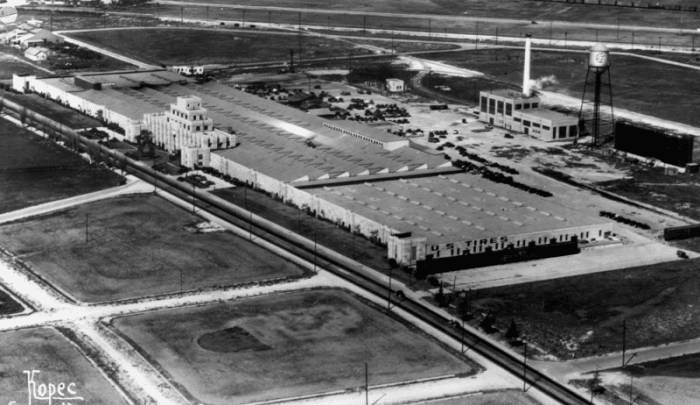
Samson Tire and Rubber Co., aerial view. Security Pacific National Bank collection.

In 1929, architects Morgan Walls and Clements (Mayan Theater) built Commerce’s most recognizable landmark, the Assyrian-themed Samson Tire and Rubber Co. factory. Back then the City of Commerce didn’t exist and this was unincorporated Los Angeles County. Soon after the factory opened, the owner was forced to sell it to the company then known as Uniroyal. The plant was shut down in 1978.

The city bought the Samson site for $14 million in 1983. Seven years later, Trammell Crow Co. was brought in to oversee the $118 million redevelopment of the site into an outlet center, as well as the construction of a 201-room Wyndham Garden Hotel next door.

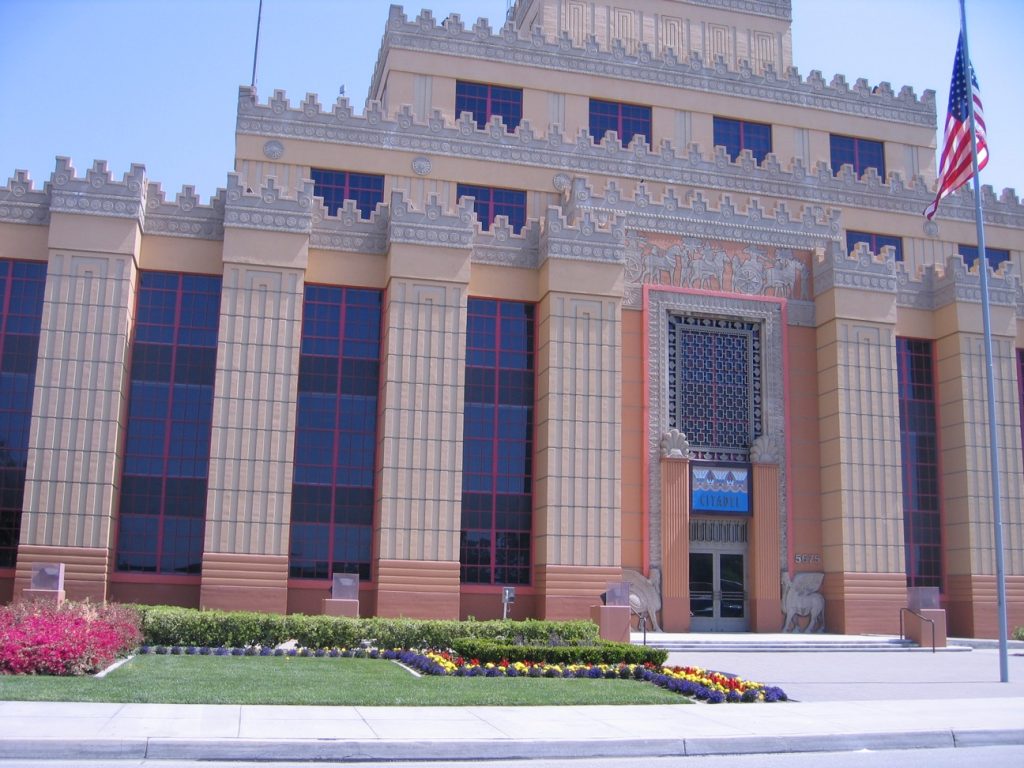
A bystander can see human-headed, winged bulls surrounding the entrance to the administration building. Steel reinforcing beams were added to make the building and wall earthquake safe.

Newly cast friezes depicting Assyrian warriors in horse-drawn chariots adorn the lobby of the tower, which served as the administration building for tire manufacturer Adolph Schleicher in 1930.

When the partnership defaulted on its ground lease with the city in 1998, Commerce officials took back the center and began marketing it to firms that would double its retail size and make it competitive with newer outlet malls in Southern California.

Craig Realty bought the Citadel Factory Stores from the City of Commerce for $50 million in July 2002, with the condition that his firm would double the size of the retail center of outlet shopping stores.  Craig Realty owns factory outlet centers in Cabazon, just outside Palm Springs, and Carlsbad. The Citadel is located at 5675 Telegraph Rd, Commerce, CA 90040.

In 2003 Craig Realty remodeled some of the property. 30-foot-tall LED screens were installed just above the wall. Next to each of those screens is a large winged creature. The creature’s official name is a Lamassu, an ancient Assyrian protective deity with cloven feet and a human face. [this section thanks to LAist]

Craig Realty Group set up a new development plan with the addition of about 125,000 square feet in 2005 and 150,000 more square feet added in 2007, bringing the mall’s total store space to 410,000 square feet, more than double its original size.

More history can be found at this link.