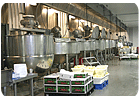
For most industrial food processing facilities, the minimum required pretreatment of water containing solids or fats (grease) consists of a three-compartment, gravity separation interceptor, also known as a clarifier or grease trap, and a sampling box. These water clarifiers can be found commonly in the yard area outside of the food prep area for operations such as seafood processing, poultry deboning, beef cutting, produce packing, commercial kitchens, commissaries, etc… The goal of these interceptors is to prevent dirty water containing solids from entering the sewer system. They are designed specifically for the sanitary removal of solid waste from food processing operations and smaller versions are commonly called grease traps in restaurants.
The Los Angeles County Health Department requires a grease trap for most food facilities. USDA meat processing facilities have clarifiers.
Aerial photo of Baker Commodities in the City of Vernon, CA. Animal by-product rendering plant.
Los Angeles Magazine has written a lengthy article about Baker Commodities, a livestock rendering plant based in the City of Vernon, California, near Downtown Los Angeles. It is the oldest animal rendering business in L.A. and the largest on the West Coast. In 2008, some 250 U.S. rendering plants like Baker took in 54 billion pounds of killed livestock—blood, bone, guts, legs, hide, muscle, and head, the detritus of slaughter—warmed the raw material in cookers, and squeezed out a clear liquid called tallow.
Baker seizes on fat wherever it can: dairy cows that have died in the heat of the Central Valley, the trimmings left over from the purchase of a Niman Ranch roast at Whole Foods, steaks and chickens whose shelf life at Pavilions has expired. The company retrieves grease from deep fryers at McDonald’s and the drippings of ribs in the Vons hot section. Rendering is the most elemental form of recycling, the regeneration of the dead into soap and scented creams. It has existed for millennia in societies, and its reach in modern America is staggering. We live in a vast cycle of fat reclamation, one that stretches from the killing floors of the Midwest to our medicine cabinets, making a stop along the way at the local Burger King.
Every restaurant and fast-food stand in L.A. has a fat reservoir called a grease trap, usually secreted under the parking lot. A trap may strain as much as 15,000 gallons of liquid fat from a kitchen’s drains, though the speed at which it fills depends on what’s cooking upstairs. A Burger King trap can take three months to fill, while an El Pollo Loco trap might need to be emptied in weeks. There are tens of thousands of grease traps citywide, each a promising revenue source for rendering companies. Baker taps around 8,000 of them.
Biodiesel! About 40 pounds of good ground beef heated to 250 degrees will produce enough tallow to make a gallon of biodiesel. The process is insanely wasteful if cattle are raised for it alone; you’d need to boil an entire cow to fill your Chevy Volt. Yet there’s no shortage of cow remnants in slaughterhouses, and U.S. production of biodiesel from renderers has grown from 78,000 metric tons in 2007 to 400,000 metric tons in 2008.
Real Mex Foods supplies more than 200 restaurants as the distribution branch of Real Mex Restaurants, Cypress, Calif., including Chevy’s, El Torito and Acapulco restaurant concepts located in Arizona, California, Nevada, Oregon and Washington. In addition, Real Mex Foods has branched into broader frozen foods processing for foodservice, co-pack and retail channels serving clients such as Sysco Distributors, El Pollo Loco, Carl’s Jr.-Green Burrito, Albertson’s and U.S. Foods.
In February, Real Mex closed its 32,000-square-foot manufacturing plant in Santa Fe Springs, Calif., and moved into a 100,000-square-foot space in Vernon, California. The city of Vernon and a developer came to us and proposed a deal where we got a 100,000-square-foot building retrofitted to a state-of-the-art USDA manufacturing plant, Angulo explains. It was an opportunistic deal. They got us into 100,000 square feet at the cost that we would have gotten a build-to-suit 65,000-square-foot building.
Food safety also was a major priority for Real Mex in building out the new plant. The company built an in-house lab and hired a complete quality assurance team. Other food safety precautions include a triple boiler system, floor foamers, centralized sanitation system, in-house chlorination system for vegetables and a full quality assurance staff.
The developer invested $10 million in the build out, while Real Mex spent about $4 million on equipment. The completely refurbished plant quadrupled the company’s previous capacity and allowed it to more than double the number of kettles, tumble chillers and blast freezers. https://en.wikipedia.org/wiki/Real_Mex_Restaurants