
CMBS Delinquencies Soar, Industrial Defaults Low Compared to Hotel, Multi-Family, and Retail


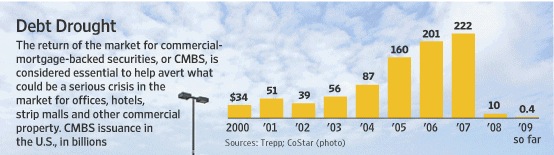
The secondary market for commercial real estate is just beginning to show new life, with the first successful sale of a commercial mortgage-backed securities (CMBS) package in over a year and several new issues in the wings spurred by the strong investor interest on that initial offering. But the positives of renewed activity are tempered by more bad news on the performance of those commercial bond deals made before the freeze.

According to a new report from commercial research provider Trepp, delinquent loans in commercial mortgage securities jumped 85 basis points to 5.65 percent at the end of November. That figure is up from just 4.8 percent a month earlier.

The delinquency rate was highest in the hotel sector, where defaults skyrocketed from 8.67 percent in October to 14.09 percent in November. According to Trepp, the upsurge came from a single Extended Stay Hotel loan. Without it in the mix, the hotel delinquency rate would have increased only 64 basis points, to a little over 9 percent.

Based on Trepp’s analysis, delinquencies on multifamily CMBS loans rose to 8.78 percent in November, up from 7.66 percent the previous month. All other sector’s showed slighter increases. Retail edged up from 4.53 percent to 4.78 percent. Industrial increased from 3.18 percent to 3.33 percent. Office loan delinquencies crept up from 3.08 percent to 3.14 percent.

Trepp says there were $65.2 billion in CMBS loans in special servicing at the end of November, an increase of $8.2 billion, or 14 percent, compared to October.  There are very few CMBS related distressed properties in the Los Angeles area.  from dsnews.com.  image from wsj

California leading growth in nation’s green jobs economy

New green jobs sprouted faster than the overall workforce expanded in California and across the nation from 1998 to 2007, according to a study released Wednesday by the Pew Charitable Trusts.

Even in the current economic downturn, investments in venture capital projects such as energy-efficiency programs and renewable energy are expected to continue expanding, fueled by billions of dollars in federal economic recovery grants, the research foundation predicted in its “Clean Energy Economy” report.

California led the nation in all categories measured. In 2007 alone, clean energy spurred the opening of 10,209 businesses with 125,390 jobs in the state. Venture capital investments in the Golden State totaled nearly $6.6 billion from 2006 to 2008, about five times greater than investments in runner-up Massachusetts.  Fields that will need more workers include clean energy production, energy efficiency, environmentally friendly manufacturing, and conservation and pollution control. Excerpts from Los Angeles Times 11/09.

This month, Standard BioDiesel expanded into Los Angeles County by leasing a land site to collect cooking oils from restaurant kitchens to process into biodiesel.  They plan on expanding to a larger land parcel within 12 months.

An Overview – Property Tax & Assessment Process

It takes three separate Los Angeles County offices, Assessor, Auditor-Controller, and Treasurer and Tax Collector to produce and account for your property tax bill and payment.

Assessor.  The Los Angeles County Assessor establishes the assessed value of your property by appraising the value of that property under applicable State laws. The assessed value is then placed on a list with all other properties in Los Angeles County and this list is called the “Assessment Roll.” The Assessor also approves and applies all exemptions, which are added to the Assessment Roll. The Assessment Roll is then presented to the Los Angeles County Auditor-Controller for further processing.

Auditor-Controller.  The Los Angeles County Auditor-Controller adds direct assessments to the Assessment Roll then applies the tax rates, which consists of general (1%) levy and debt service (voter & bonded) tax rates to the value to create an Extended Assessment Roll. The Extended Roll is then sent to the Los Angeles County Treasurer and Tax Collector for individual tax bill distribution and payment collection.

Treasurer and Tax Collector.  The Los Angeles County Treasurer and Tax Collector receives the Extended Roll, prints and mails the property tax bills to the name and address on the Extended Roll. The Treasurer and Tax Collector collects secured and unsecured taxes. Secured taxes are taxes on real property, such as vacant land, structures on land, i.e. business/office building, home, apartments, etc. Unsecured taxes are taxes on assessments such as office furniture, equipment, airplanes and boats, as well as property taxes that are not liens against the real property.