
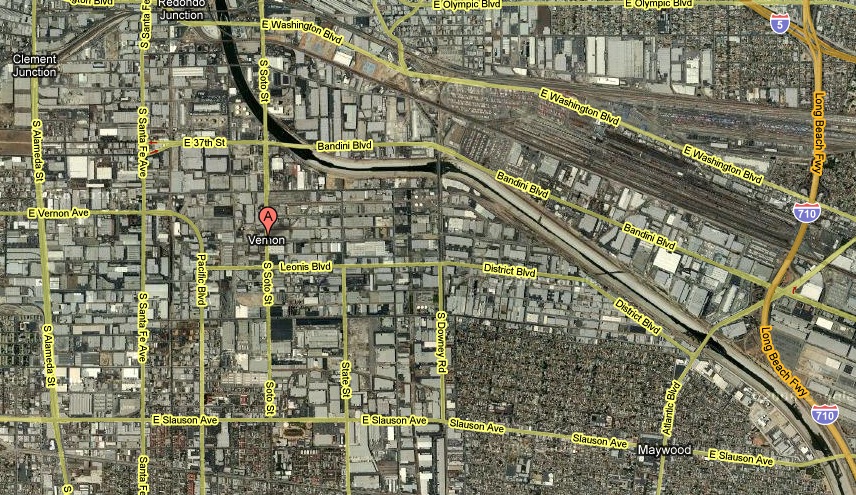
The City of Vernon And Its Industries

city-of-vernon-aerial1

The City of Vernon is the smallest among the cities of Los Angeles County when ranked by geographic area or population. The city’s economic impact, however, is far larger than one might expect. Indeed, as one of Los Angeles County’s “industrial cities” – along with the Cities of Commerce and Industry – Vernon is a vital economic center.

Given its industrial profile, Vernon plays its biggest role in the Food Manufacturing area. Vernon-based food product companies employ almost 10,700 workers, more than 15% of the Los Angeles County total for this group. Vernon also plays an important role in the region’s Fashion–Apparel and Textile Design/Manufacturing/ Wholesale industry cluster, with more than 11,200 employees or 10.66% of the L.A. County total.

Other regional industry clusters in which Vernon plays a large role include Furniture and Home Furnishings (with an employment share of 5.53%), Fabricated Metal Products and Industrial Machinery (with 3.4%), Toys (with 2.4%), Auto Parts (also 2.4%), and Wholesale Trade and Logistics (with nearly 2%).

Vernon, due to its historic role as a meat packing center, has long been home to a variety of animal waste processing and rendering industries. Rendering, for those who don’t know, is a process that converts waste animal tissue into stable, value-added materials such as lard, tallow or bone meal. Rendering can refer to any processing of animal byproducts into more useful materials, or more narrowly to the rendering of whole animal fatty tissue into purified fats.

Sources: City of Vernon, California Employment Development Department (QCEW data series), LAEDC.
Labor Market Update – Continued Gloom Along with Other Indicators

USA-IMMIGRATION/AMERICANAPPAREL

The Bureau of Labor Statistics released its latest U.S. Labor Market Report on Friday, covering the U.S. employment situation in December, and the news was depressing.  Total nonfarm employment fell by -524,000 jobs in December, and the job losses in October and September were revised down to -584,000 jobs and -423,000 jobs respectively.  In percentage terms, employment has declined by -1.12% in the last three months.  This was the biggest three-month decline since mid 1980 and before that, the first three months of 1975 (Both years saw severe recessions).

Leading Economic Indicators

The manufacturing and construction sectors continued to shrink, with job counts plunging by -791,000 jobs and -632,000 jobs respectively compared to December 2007.  In manufacturing, about 46% of the total job losses came in just four sectors:  motor vehicles & parts (-162,000 jobs and counting), furniture manufacturing (-71,000 jobs), wood products (-76,000 jobs), and textiles & apparel (-56,000 jobs).

Labor market conditions have deteriorated significantly in recent months, and the damage is spreading rapidly.  About 55% of the jobs lost during 2008 were in manufacturing and construction.  However, that share has been dropping recently, as jobs are disappearing in almost all sectors of private industry (except health services, private education, and mining).  The nation’s unemployment rate hit bottom in March, 2007 at 4.4%, when 6.7 million workers were jobless.  By last month, the number of workers without a job had grown to 11.1 million, an increase of 4.4 million unemployed.  The nation’s labor markets are quite troubled, and more bad news is likely in the next few months.

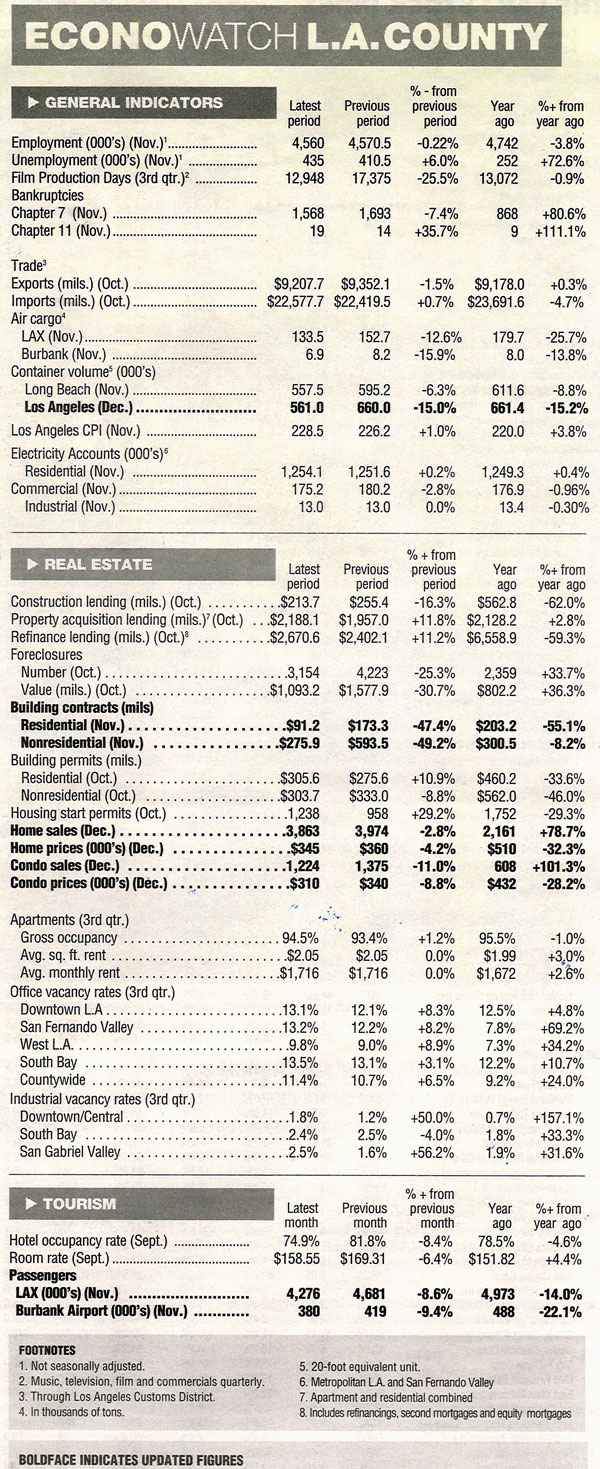
Although these data are countrywide, the Southern California and Los Angeles economies are not unlike them.  These leading indicators are likely an omen of decline for the local warehousing and manufacturing industries and the real estate they occupy.