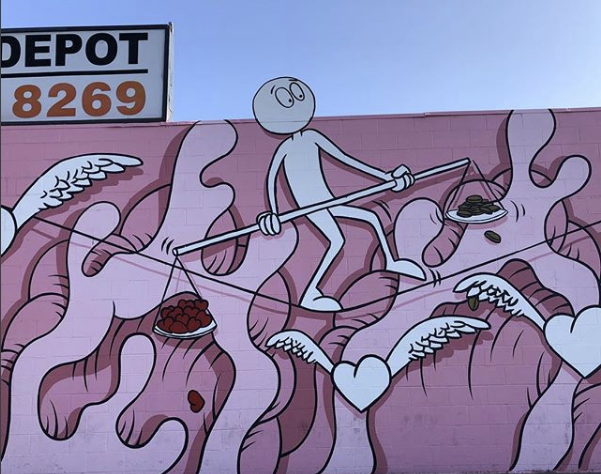
Los Angeles has an abundance of street art, especially DTLA and in the DTLA Arts District. I and many downtown dwellers view and define “street art” as artwork in a public space that has a generally pleasing design. Contrast that with typical street-gang graffiti, which was primarily composed of dreadfully designed words and dominated the public realm prior to 2000. Most denizens consider graffiti to be blight. Street art adds value to the public realm as well as property values, especially in areas such as the Arts District. Check out some great examples here: https://www.instagram.com/explore/tags/lastreetart/. A large portion of DTLA street art has been painted on industrial buildings.
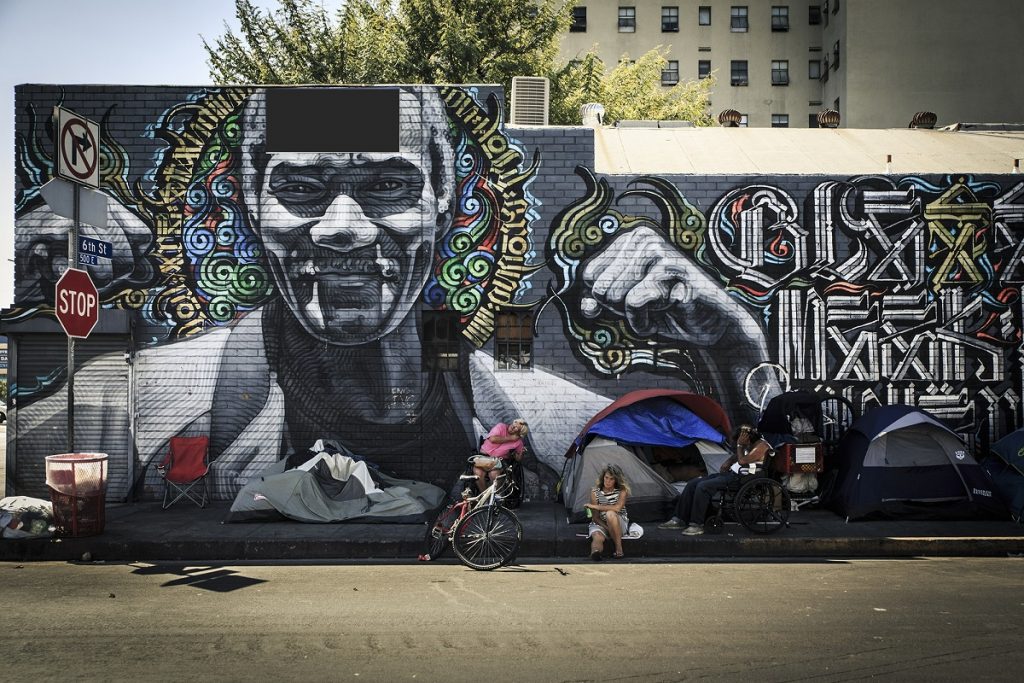
Street art is not exclusive to gentrifying areas. See below in the heart of Skid Row with homeless encampments.
The Alameda Corridor is a 20-mile railroad “expressway” that connects the World Ports of Los Angeles and Long Beach with the national rail system. The Corridor began operating in April 2002 and its main purpose was to alleviate truck traffic on local freeways and create a more efficient way to move cargo containers from the Ports of Los Angeles and Long Beach to the Downtown Los Angeles rail yards. Effectively, the Corridor has created an efficient solution to get cargo containers from the Ports to major inland distribution points in the Inland Empire and as far east as Kansas City and Chicago. As of April 2016, the Alameda Corridor was handling an average of almost 36 trains per day and over 11,000 TEU’S. The Alameda Corridor Transportation Authority (ACTA) owns and operates the Corridor and charges user fees to the railroads on a per-TEU basis.
The five-county Greater Los Angeles region represents the largest industrial market in the nation with approximately 1.0 BSF, connected by the region’s modern sea ports, highways, railways and airports. The region historically has boasted the strongest market
fundamentals in the country relating to rents, vacancy and availability rates and pricing. In Greater Los Angeles, the overall vacancy rate was 1.2% as of the fourth quarter of 2017. The market also generated 9.3 MSF of gross activity in the fourth quarter.
Although the local CPI has hovered between 0-2% since the recession. In 2017 we have seen it steadily rise above 2% to a current 2.5%. This will affect the annual increase increments for new leases signed. Historically industrial escalation clauses demanded a floating increase between 3-5%, whatever the CPI at the time.

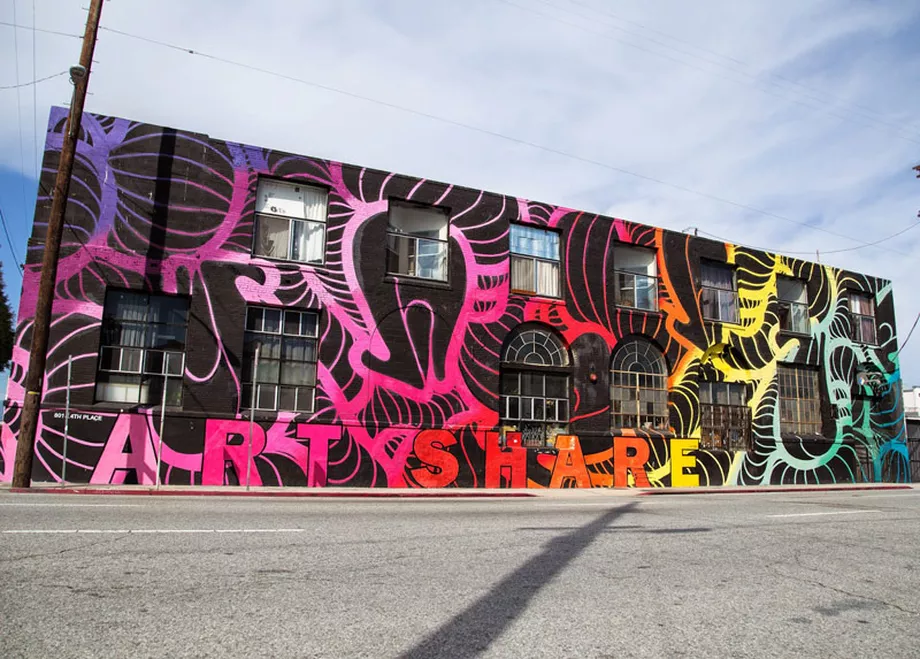
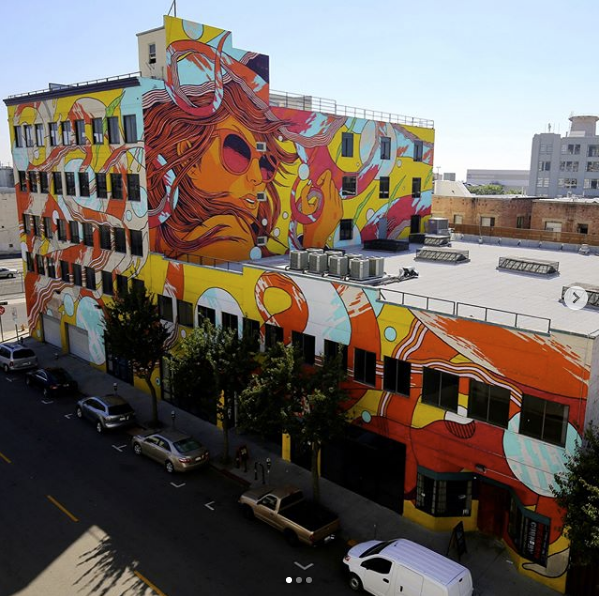
 Los Angeles has an abundance of street art, especially DTLA and in the DTLA Arts District. I and many downtown dwellers view and define “street art” as artwork in a public space that has a generally pleasing design. Contrast that with typical street-gang graffiti, which was primarily composed of dreadfully designed words and dominated the public realm prior to 2000. Most denizens consider graffiti to be blight. Street art adds value to the public realm as well as property values, especially in areas such as the Arts District. Check out some great examples here: https://www.instagram.com/explore/tags/lastreetart/. A large portion of DTLA street art has been painted on industrial buildings.